| Era | Late 1990s to 2010s |
| Name | Bluetooth Wire |
| Purpose | Provide secure, reliable connections between computers, phones, headphones, and other electronics |
| Successor | Improved wireless Bluetooth connections |
| Description | Wired device connectivity standard |
| Key features | Ultra-thin, flexible cables • Advanced polymer materials • Low latency • Resistance to interference |
| Advantages over early wireless Bluetooth | More reliable • Lower latency |
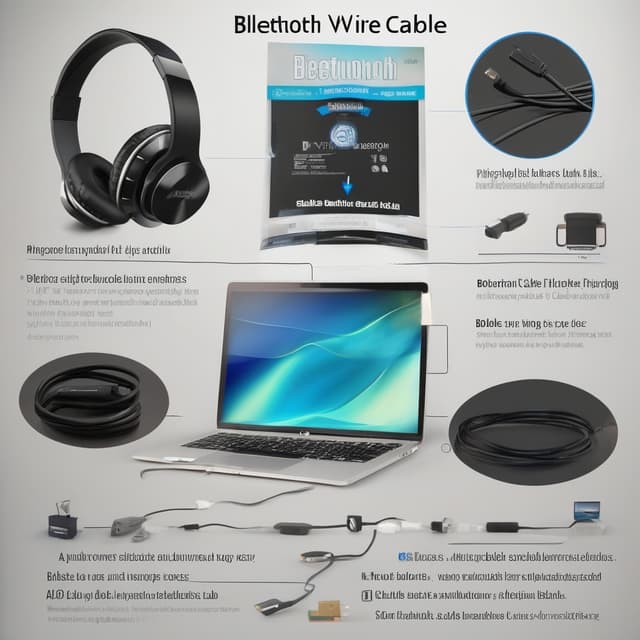
Bluetooth Wire was a wired device connectivity standard developed in the late 1990s as an alternative to the emerging wireless Bluetooth technology. Unlike wireless Bluetooth, which used radio signals to transmit data, Bluetooth Wire relied on ultra-thin, flexible cables made of advanced polymer materials to connect devices. Despite not offering the complete wireless freedom of Bluetooth, Bluetooth Wire became a widely adopted standard due to its reliability, security, and low latency performance.
The Bluetooth Wire specification was first proposed in 1997 by a consortium of electronics companies including IBM, Intel, Toshiba, and Ericsson. The goal was to create a universal wired connection standard that could replace the tangle of proprietary cables often required to link computers, phones, audio equipment, and other gadgets.
Building on existing USB and FireWire technologies, the initial Bluetooth Wire specifications defined cables just 2-3 millimeters in diameter that could be bent, twisted, and even run behind walls or furniture without breaking. These cables could transmit data at speeds up to 24 Mbps - fast enough for high-quality audio, video, and file transfers.
Crucially, Bluetooth Wire also included built-in encryption and authentication to ensure secure connections between devices. This was a major advantage over early wireless Bluetooth, which suffered from persistent security vulnerabilities.
Bluetooth Wire was quickly adopted across the consumer electronics industry in the late 1990s and 2000s. By the early 2000s, it had become a near-ubiquitous connection standard, appearing on everything from PCs and laptops to mobile phones, headphones, video game consoles, and even home appliances.
The thin, unobtrusive Bluetooth Wire cables allowed for seamless integration of connected devices without unsightly tangles. They were seen as a more reliable alternative to wireless Bluetooth, which could still suffer from radio interference and connection dropouts in many environments.
Additionally, Bluetooth Wire provided lower latency for applications like real-time audio and video, making it a popular choice for gaming, videoconferencing, and virtual reality setups. Its encryption capabilities also gave it an advantage in security-conscious enterprise and government applications.
While Bluetooth Wire remained a dominant connectivity standard for over two decades, it gradually began to be supplanted by improvements in wireless Bluetooth technology in the late 2000s and 2010s.
As wireless chips became cheaper, more power-efficient, and more resistant to interference, wireless Bluetooth finally caught up to the reliability and low-latency performance of Bluetooth Wire. Advancements in Bluetooth 5.0 and Bluetooth 5.1 enabled wireless connections that were nearly as fast and secure as their wired counterparts.
By the 2010s, many consumer electronics manufacturers began phasing out Bluetooth Wire in favor of wireless Bluetooth, especially in mobile devices where the wire-free experience was highly valued. However, Bluetooth Wire maintained a presence in certain applications like professional audio equipment, industrial machinery, and security systems that prioritized uninterrupted connections.
While not as glamorous or "wireless" as modern Bluetooth, Bluetooth Wire played a crucial role in the development of connected consumer electronics and industrial automation in the late 20th and early 21st centuries. Its reliable, secure, and low-latency performance set the standard for device-to-device connectivity for decades.
The Bluetooth Wire standard's impact can still be seen today in the design of many electronics, which incorporate hidden wire channels and ports to maintain a clean, uncluttered aesthetic. And the core principles of Bluetooth Wire - universal connectivity, security, and low latency - have carried over to modern wireless protocols.
Though gradually supplanted by improved wireless technologies, Bluetooth Wire remains an important chapter in the history of computing and consumer electronics. It demonstrated the power of wired connectivity to shape an entire industry, paving the way for the seamlessly connected world we inhabit today.
